miércoles, 17 de febrero de 2016

TRANSLATING THE SPANISH VERB 'BAJAR':

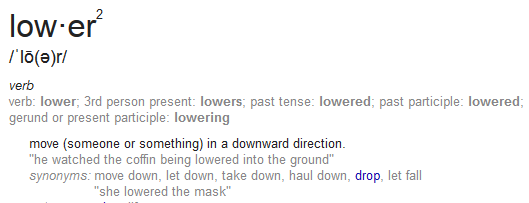
Many students in our online English classes of lower levels translate 'bajar' with the adjective, noun or adverb 'low'. The verb is actually 'to lower'. So we'd say 'we lower prices in the sales' NOT 'we low prices in the sales'. We can also apply other verbs such as 'decrease', 'move down', 'drop' or 'reduce'.

http://www.clasesinglesonline.com


miércoles, 3 de febrero de 2016

COMMON VOCABULARY - 'TO TURN AN AGE':

In English when we have birthdays we use the verb 'to turn + age’. For example, one can say 'I will turn 39 next week' or 'she turned 16 a fortnight ago' when one becomes older. Hoping that helps. Have a great day.

http://www.clasesinglesonline.com

sábado, 16 de enero de 2016

TRANSLATING 'AMANECER' AND 'ANOCHECER':

In our Skype English classes (online) Spanish students often forget the words to translate 'anochecer' and 'amanecer' into English. We can use 'dawn', 'daybreak' or 'sunrise' for 'amanecer' whilst 'dusk' or 'sundown' or 'sunset' or 'nightfall' are used for 'anochecer'. 'Twilight' is the soft glowing light when the sun is still below the horizon. Hope that helps.
http://www.clasesinglesonline.com


lunes, 4 de enero de 2016

‘CARRERA’ IS A FALSE FRIEND:

In our Skype English online classes Spanish students often wrongly translate ‘carrera’. One of the meanings of ‘carrera’ in Spanish refers to studies which are done at university whilst this is not the case in English. ‘Career’ refers to your professional working life which is normally carried out after university, school or college is finished. It does not refer to studies done at university in English. When you study at university this is often called in the UK a ‘degree course’ a ‘degree’ or simply your ‘studies’. Happy New Year!
http://www.clasesinglesonline.com


jueves, 17 de diciembre de 2015

SOME VERBS REQUIRE AN OBJECT IN ENGLISH:

Some verbs must have an object in English. These are called transitive verbs. The object is the person or thing affected by the action described by the verb. For example, many people translate the sentence ‘me gusta’ with ‘I like’. This is really bad. What you must employ is an object as ‘like’ is a transitive verb. For example, you could say ‘I like it/her/the film/the sunny day’ etc. So please avoid just saying ‘I like’ or ‘I like a lot’ or ‘I don’t like’. Similarly, we must not say ‘the film, I like’. The word order is wrong so we must say ‘I like the spray’ (subject, verb, object).

Common transitive verbs that students have issues with include:

To like
To miss (extrañar)
To enjoy
To bring
To give
To send
To leave
To make
To owe
To tell
To show
To use

http://www.clasesinglesonline.com
lunes, 7 de diciembre de 2015

COMMON PHRASAL VERB: 'TO BE PUT OFF'

This means that something or someone discontinued your desire for something or someone.

Examples: 1. The hair in my soup put me off wanting to eat the soup. 2. The girl's strange habits put me off her. 3. They no longer want to vote for that candidate. His speech put the voters off.

martes, 1 de diciembre de 2015

¿POR QUÉ TE FALLAS CON TU INGLÉS?

Aquí está un consejo para aprender el inglés más facilmente que damos a los alumnos de nuestros clases de inglés online (vía skype).

Minimice su esfuerzo estudiando menos gramática:

Teniendo una base de gramática, la mejor y más divertida forma de mejorarla es conversando y conversando mientras alguien corrige tus errores gramaticales como en nuestras clases de inglés online. Hablar correctamente de temas entretenidos e interesantes es mucho más divertido que estudiar solo con los libros de gramática.
http://www.clasesinglesonline.com